Agent sprawl: the hard part is the count, not the agent
Dataiku launched Agent Management on 24 September to count AI agents across Copilot Studio, Agentforce, Bedrock and Vertex. UK buyers have to decide who owns the register, what it costs and who switches agents off
- Dataiku’s new product connects to Microsoft, Salesforce, AWS, Google, Databricks and Snowflake agent platforms and ships in October, priced per instance with monitoring metered per agent.
- Dataiku-commissioned research found 90% of CIOs confident they track every agent, yet 81% admit they lack oversight of agents built outside approved systems.
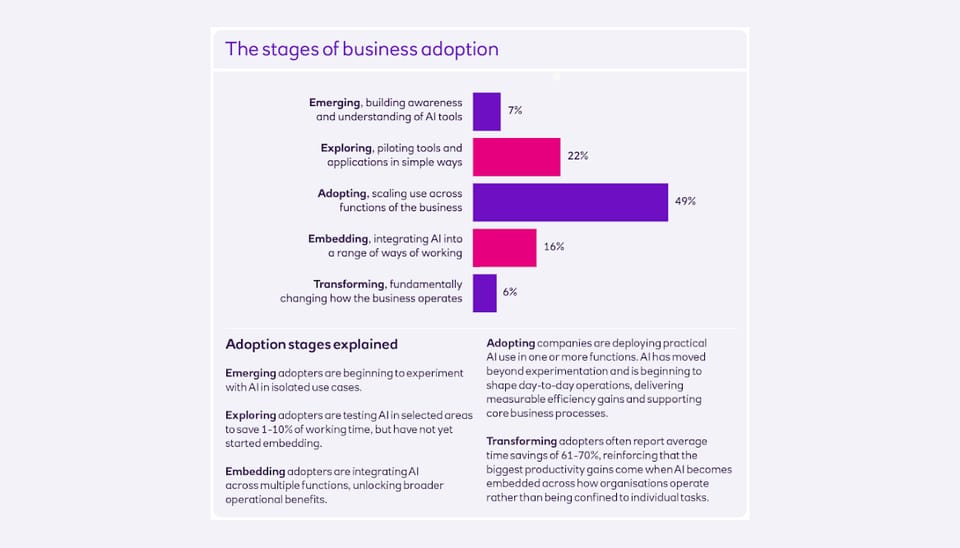
- KPMG figures reported by ITPro put UK agent adoption at 35% of organizations; globally, only 55% run a formal AI management infrastructure.
On 24 September, at its Succeed conference in New York, Dataiku launched Agent Management, a standalone product that finds every AI agent a company runs, whichever platform built it, measures its business and technical performance and flags the ones carrying the most risk. The release lists the platforms it connects to: Amazon Web Services (AWS) Bedrock, Databricks Agents, Google Vertex, Microsoft Copilot Studio and Azure Foundry, Salesforce Agentforce, Snowflake Cortex and Dataiku’s own agents, with OpenTelemetry for anything custom. It ships in October, priced per instance a year, with monitoring metered per agent.
Read that platform list again. It is the software estate of a UK organization: the Microsoft tenant, the Salesforce instance, the cloud data platform. Each is a platform that teams already use to run agents. Dataiku’s argument is that each platform sees only its own agents, so most enterprise agent estates have no single owner, no stated purpose and no risk rating.
Florian Douetteau, co-founder and chief executive of Dataiku, puts it this way in the release: “Ask a bank how many servers it runs, and you get an answer to the decimal. Ask how many AI agents it’s running, and you get a shrug or a guess.”
He is selling software, so the line deserves scrutiny. But the point stands without him. Agents are spreading across the platforms UK organizations already run, and the hard question is not how to build the next one but who holds the register, what they cost and who switches them off.
The platforms cannot see each other
Dataiku cites IBM’s AI in Motion research that fewer than one in five organizations keep a complete, current inventory of their AI systems; the release gives no sample size. Its own numbers are starker and need a label. The Global AI Confessions Report: CIO Edition, 2026, published the same day, is Dataiku-commissioned research: an online survey of 685 CIOs in eight countries, including the UK, run by The Harris Poll between 9 and 29 July 2026. Of those CIOs, 90% said they were confident they had complete tracking of every agent. Asked about agents created outside approved systems, 81% said they lacked complete oversight. Some 84% said employees are creating agents faster than IT can govern them, and only 21% reported full, near-real-time visibility into AI costs by business unit or use case. Nearly half (47%) said they had already decommissioned more than 20 agents this year.
A vendor that sells governance software has found that customers need governance software. Still, the gap between the 90% and the 81% is the kind of contradiction that only appears when nobody owns the count.
UK adoption is outrunning governance
The UK figures come from KPMG. Its Global AI Pulse survey, reported by ITPro on 24 September, found that more than one-third (35%) of UK organizations report significant adoption of AI agents, up from 30% in the first quarter of 2026. Some 64% place accountability for AI decisions at C-suite level or above. Globally, 55% run what KPMG calls a formal AI management infrastructure; KPMG’s release gives that figure for all 2,131 senior leaders it surveyed in 20 countries, not for the UK alone. Paul Henninger, partner and head of technology and data at KPMG UK, said, in comments ITPro reported: “Deploying AI is only the first step.”
Put those together and the shape of the market is clear. A third of UK organizations are running agents in earnest, nearly half of organizations worldwide have no formal structure to manage AI and, if Dataiku’s CIOs are any guide, the ones who believe they have the full picture probably do not.
Who owns the register
Many UK organizations have spent 2026 building agents: a Copilot Studio agent for the finance team, an Agentforce agent for customer service, a Bedrock pilot for the data team. Each is a project with a sponsor, and, on Dataiku’s figures, most CIOs say the building runs faster than IT can govern it.
The harder job sits above that. Someone has to hold the register of every agent across the Microsoft, Salesforce, AWS and Google estates; decide which ones have an owner and a purpose; run the tests that keep an audit trail; attribute the cost of each to a business unit; and switch off the ones nobody claims. That is a standing function, not a project, and it looks a great deal like what, Dataiku notes, every large company already does for the software it runs: recording who owns it, what it costs and when it renews, whether in-house or with a supplier.
Three things follow for the UK organizations buying AI.
First, name the owner of the register before buying the tool. Dataiku charges per instance and meters per agent, so the cost of governance grows with the agent count, and a tool with no owner is one more thing nobody counts. Any supplier that builds or runs agents on the organization’s behalf should report into the same register; suppliers holding automation across many customers face the same count at scale.
Second, give the CFO the cost by business unit, not the total. Dataiku’s survey found that 72% of CIOs expect their AI budgets to be cut or frozen if performance targets are missed by the end of 2026. Cost attribution is the argument that survives a budget review; a single AI line on the ledger is the one that gets frozen.
Third, demand a register that sits above every platform. The value of the layer is that it covers Copilot Studio, Agentforce and Bedrock alike. A buyer who accepts one vendor’s monitoring sees one vendor’s agents, which is the problem Dataiku describes, not the answer to it.
Agents will get built whether or not IT is asked. The organization that can answer Douetteau’s question to the decimal is the one whose AI budget survives the review.

Get The VETTDD BriefingThe week in the technology channel, every week.
Subscribe free- Dataiku, “Dataiku Launches Agent Management to Track and Manage Performance of AI Agents Built and Running on Leading Platforms”, press release, 24 September 2026. https://www.dataiku.com/company/news/dataiku-agent-management-general-availability
- Dataiku, “81% of Global CIOs Say They Have Lost Oversight of Their Own AI Agents”, press release on the Global AI Confessions Report: CIO Edition, 2026 (The Harris Poll, 685 CIOs, 9–29 July 2026), 24 September 2026. https://www.dataiku.com/company/news/global-ai-confessions-report-cio-edition-2026
- ITPro, “UK firms sharpen AI governance focus”, report on KPMG’s Global AI Pulse survey, 24 September 2026. https://www.itpro.com/technology/artificial-intelligence/uk-firms-sharpen-ai-governance-focus
- KPMG, “New KPMG AI Pulse Survey: As AI maturity converges, leading organizations show what AI at scale requires”, press release on the Global AI Pulse Q3 2026 (2,131 senior leaders, 20 countries), 24 September 2026. https://kpmg.com/xx/en/media/press-releases/2026/09/new-kpmg-ai-pulse-survey-as-ai-maturity-converges-leading-organizations-show-what-ai-at-scale-requires.html