
The VETTDD 50 · UK startups · 2026Infrastructure and deep tech
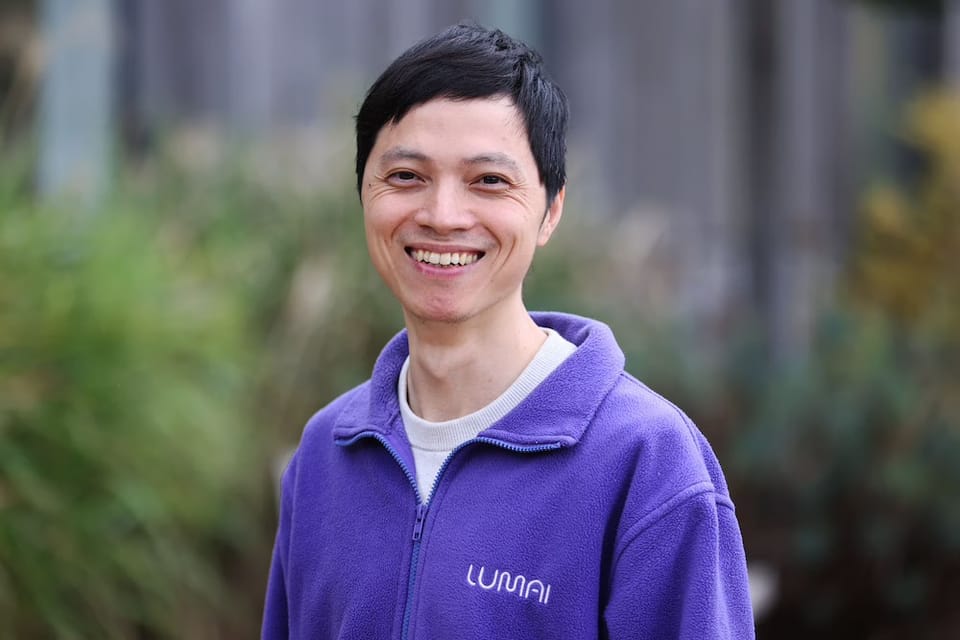
Xianxin Guo
CEO and Co-Founder, Lumai · lumai.ai ↗
AI data centers are running into limits on power. Lumai’s chief executive says doing the math with light rather than electrons can cut inference energy use by up to 90%
- Lumai Iris optical inference servers launched
- Apr 2026
- energy saving Lumai claims against conventional architectures
- 90%
- raised in April 2025, led by Constructor Capital
- $10m+
Dr Xianxin Guo is co-founder and chief executive of Lumai, an optical computing company spun out of the University of Oxford in 2021. A physicist with a PhD in quantum physics and nonlinear optics from the Hong Kong University of Science and Technology, he was a postdoctoral researcher at the University of Calgary and an 1851 Research Fellow at Oxford. Lumai credits him as the primary inventor of its core technology, which he developed with co-founder Dr James Spall, now chief technology officer.
Guo joined the company’s leadership as head of research and has since become chief executive. In 2024 the Royal Academy of Engineering selected him for its Shott Scale Up Accelerator.
Computing with light
Lumai’s processors perform the matrix operations at the heart of AI models using light moving through three dimensions, rather than transistors on a flat chip. A digital processor handles control while an optical tensor engine does the math. Guo’s argument starts with physics. “The limitation of silicon scaling is primarily down to the physics – frequencies are not increasing, and the number of transistors that can be switched is limited by thermals,” he told Unite.AI.
In April 2025 Lumai raised more than $10m (£7.5m) led by Constructor Capital, with IP Group among the investors. On 28 April 2026 it launched Lumai Iris, a family of inference servers that it describes as the first optical computing system to run billion-parameter large language models (LLMs) in real time. The first model, Iris Nova, runs Llama 8B and 70B models and is available for evaluation by hyperscalers, neoclouds, enterprises and research institutions. Lumai says Iris can use up to 90% less energy than conventional architectures.
“By shifting the computation paradigm from electrons to photons, Lumai can deliver an order-of-magnitude increase in performance with significant energy savings,” Guo said at the launch. The UK’s Advanced Research and Invention Agency (ARIA) is working with the company, and Lumai won the Falling Walls Science Breakthrough of the Year award for 2025.
Why it matters to UK technology buyers
Lumai’s launch pointed to forecasts that global data center power demand will double by 2030. If optical inference delivers the savings Lumai claims at production scale, UK data center operators and large AI users would gain another route to more inference per megawatt than adding GPUs. “The demands on existing AI processors necessitate an urgent search for alternative scaling pathways,” said Suraj Bramhavar, program director at ARIA. The evaluation program is where Lumai’s claims will be tested outside the lab.
Guo has taken an Oxford physics result to a working server running commercial AI models in five years. That is the hardest stretch of deep tech; the next is proving the economics to buyers.
Xianxin Guo’s leader profile →The full 2026 list →
- Lumai, Lumai launches the world’s first optical computing system for real-time, billion-parameter LLM inference, 28 April 2026
- GlobeNewswire, Lumai launches the world’s first optical computing system for real-time, billion-parameter LLM inference, 28 April 2026
- Lumai, About
- Unite.AI, Dr Xianxin Guo, CEO and co-founder of Lumai: interview series, 28 April 2026
- Tech.eu, Lumai secures over $10m investment for optical processing tech, 2 April 2025