
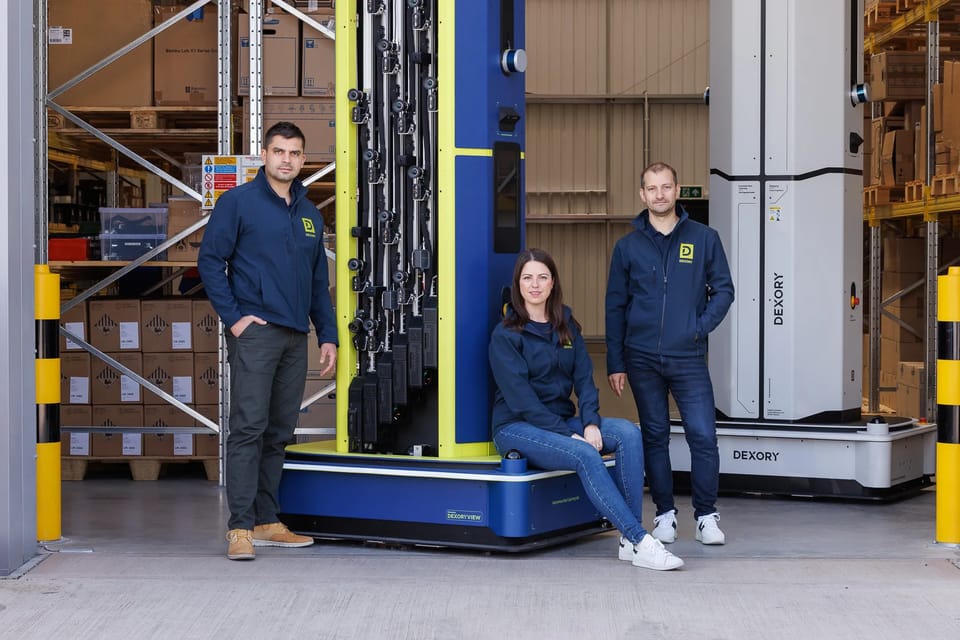
On 21 October Dexory, the Wallingford-based maker of autonomous robots that scan warehouse racks, made two announcements from London. It is testing Nvidia’s Halos safety platform and plans to roll the technology out across its fleet worldwide. It has also added one of Nvidia’s Cosmos foundation models to Storage Health, the part of its DexoryView software that flags problems on the racks.
Dexory’s robots drive the aisles day and night, capturing high-resolution images of the racks for its DexoryView software. The company says they run 24/7 alongside people, forklifts and other equipment. When it raised $165m (£123m) in October 2025, including a $100m (£75m) Series C led by Eurazeo, it named GXO, Maersk, DHL, Stellantis and GE Appliances among its users.
Neither release gives a performance figure: there is no accuracy rate for the new rack checks, no date for the fleet rollout and no word on cost. Dexory says it is “testing” Halos and “exploring” what it can build on it.
Even so, the two questions an operations director asks of any robot on a shared warehouse floor – whether it can hurt anyone, and whether its readings can be trusted – are moving partly onto a chip supplier’s platform, and with them part of the engineering a buyer relies on.
What Halos adds to the safety case
Nvidia launched Halos for Robotics on 22 June 2026. It pairs IGX Thor, an industrial compute module with built-in functional safety hardware, with a safety operating system called Halos Core and a design that uses a building’s own cameras to watch robots from outside. Nvidia also runs an AI Systems Inspection Lab, accredited to ISO/IEC 17020, which inspects how a partner’s product uses those parts and issues a certificate. The partner then takes that certificate to a certification body such as TÜV Rheinland, TÜV SÜD, SGS or UL Solutions.
Nvidia’s pitch is that because its own elements are assessed in advance, robot makers spend their certification effort only on their own application logic, cutting time and cost. The lab had 43 members when Halos launched, among them Boston Dynamics, Agility and KION Group.
Nvidia named Agility as an adopter at launch, with Agility building IGX Thor and Halos OS into the system its Digit humanoid uses to detect people. Nvidia’s own example of the problem Halos addresses is the autonomous forklift, whose onboard sensors can read cargo or a trailer wall as an obstacle and slow or stop the truck.
Dexory says it is exploring the Halos stack to build “a single-board architecture” that improves safe autonomy and widens what its robots can perceive with their own sensors. Its chief executive and co-founder, Andrei Danescu, said: “Our robots operate every day in highly dynamic environments giving us a unique perspective on what safe autonomy requires in the real world.”
Rack checks on a borrowed model
The second announcement is further along. Storage Health analyzes the high-resolution images the robots take as they pass, and flags anomalies at each rack level. Dexory has fine-tuned Nvidia’s Cosmos-Reason2-2B model on its own warehouse imagery to recognize open boxes, goods pulled forward from their expected position and misaligned pallets. The model runs as a second layer when Dexory’s existing models return low-confidence results.
Dexory tested both the 2B and 8B versions of the model and chose the smaller one for production, citing its mix of accuracy and deployment efficiency, with tests on data from several warehouse sites. Its release notes that storage issues “can be difficult to spot, particularly at height or in densely packed storage areas”. Danescu puts the case for the model in terms of variety: “Warehouses are dynamic environments, with storage conditions varying significantly across sites and operations.”
Dexory has a large pool of warehouse data to draw on. In a post on 14 October, Danescu said the company has captured data from more than 1.5 billion pallets and 75,000 warehouse operational days.
Who stands behind the answer
For a warehouse operator or a logistics provider’s customer, a Dexory robot now carries more of Nvidia’s work. Its rack checks call on a model Nvidia trained and Dexory adapted when Dexory’s own models are unsure, and its safety system may come to sit on an Nvidia board whose safety elements Nvidia says are preassessed, with the integration inspected by Nvidia’s own lab. A shared, pre-inspected safety layer could make certification quicker for Dexory and for the other robot makers that use it. It also means a fault in a robot’s judgment, or in its sense of a person stepping into the aisle, would have two companies’ engineering behind it.
Dexory has published no figure for how often Storage Health is right, and no date for Halos to reach the fleet. Those two numbers will show whether the Nvidia parts change anything on a warehouse floor.


Get The VETTDD BriefingThe week in B2B technology, every week.
Subscribe freeSources
- Dexory, “Dexory advances safety for autonomous robotics”, press release, 21 October 2026. https://www.dexory.com/insights/dexory-advances-safety-for-autonomous-robotics
- Dexory, “Dexory identifies a broader range of warehouse storage issues with Storage Health and NVIDIA Cosmos”, press release, 21 October 2026. https://www.dexory.com/insights/dexory-identifies-a-broader-range-of-warehouse-storage-issues-with-storage-health-and-nvidia-cosmos
- Dexory, Andrei Danescu, “From visibility to intelligence to action: The next chapter for Dexory”, company blog, 14 October 2026. https://www.dexory.com/insights/from-visibility-to-intelligence-to-action-the-next-chapter-for-dexory
- Dexory, “Strong customer demand enables Dexory to secure $165M in funding”, press release, 14 October 2025. https://www.dexory.com/insights/strong-customer-demand-enables-dexory-to-secure-165m-in-funding
- Nvidia, “Inside NVIDIA Halos for Robotics: a full-stack functional safety system for physical AI”, developer blog, 22 June 2026. https://developer.nvidia.com/blog/inside-nvidia-halos-for-robotics-a-full-stack-functional-safety-system-for-physical-ai/
- European Central Bank, euro foreign exchange reference rates, 21 October 2026. https://www.ecb.europa.eu/stats/eurofxref/eurofxref-daily.xml

Editor
The VETTDD editorial desk. Interviews, analysis, columns and news briefs on the decisions shaping B2B technology.
More from Editor
The week in B2B technology, in five minutes
Every week: the interview, the briefs that matter and one view from the editor. Free.