

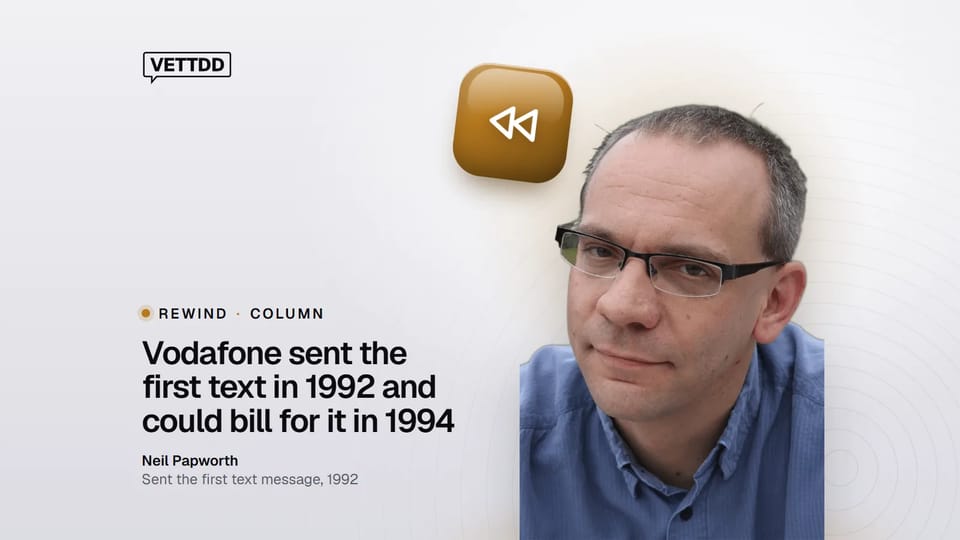
On 3 December 1992 a test message traveled over the Vodafone network to an Orbitel 901 handset that weighed 2.1kg. It read “Merry Christmas”. Neil Papworth, then a 22-year-old software programmer working as a developer and test engineer on a Short Message Service (SMS) for his client Vodafone, sent it from a computer. It went to Richard Jarvis, whom Vodafone’s 2022 account names as a chief engineer.
Vodafone’s own account, published for the 30th anniversary in December 2022, says Jarvis was to show the message to Gerry Whent, then chief executive, at a Christmas drinks party during a visit to the Newbury offices of Vodata, Vodafone’s commercial division. According to some eyewitnesses, it says, Whent “didn’t seem overly impressed”. The company calls the story legend and rumor in the same article, and says it remains the official version.
Vodafone, founded in Newbury on 17 July 1984 by Whent and Ernest Harrison after emerging from the electronics company Racal, carried its first call on 1 January 1985 on a 5.5kg Transportable VT1 that cost more than £1,400. By the end of 1992 a text could be sent from a computer, but there was no system to bill for one.
The record that followed shows a product built in three stages after the message itself worked: billing, handsets and delivery between networks. Charging for a text took until 1994 and sending one to a rival’s customer until 1999, and the people who built the service say they did not predict how large it would become.
A billing system before a business
Dave Pearce was the Vodafone SMS product manager given the job of commercializing the service. He recalls that the first text he saw was not the Christmas greeting but the word “test”, sent by a Vodafone engineer, Ian Harris, during development. The industry, he says, doubted the idea of messages capped at 160 characters. “Some telcos thought texts would only be useful for letting people know they had recorded phone messages!” he told Vodafone. “The culture back then was very voice-focused.”
Pearce’s team saw a use in timely push notifications, his example being road traffic conditions. Vodafone commercialized the service in 1994. Building the billing systems that made that possible, Pearce says, involved “18 months of pain”. The network could deliver a message in December 1992; the company could not charge for one until it had built a billing system for it.
Handsets were the second gap. In 1993, a year after Papworth’s test, Nokia added an SMS feature with a distinctive beep to signal an incoming message, according to Vodafone’s 25th anniversary article of December 2017. Typing was slow: Ben Wood, a former Vodafone employee, curator of the Mobile Phone Museum and chief analyst at CCS Insight when Vodafone interviewed him in 2022, recalls that spelling his three-letter name meant pressing the 2 key twice, then the 3 and 6 keys twice each.
The volume came from other networks
The third gap was delivery between networks. Texting spread worldwide once phones could both send and receive messages and once a text could reach a customer on any mobile network, which Vodafone dates to 1999, seven years after the first message. Until then a text was worth only as much as the share of a sender’s contacts who happened to use the same operator.
Vodafone’s 2022 account says texting to vote in television competitions and texting to donate to charity “proved incredibly popular”. Inside Vodata, Wood says, staff were sending hundreds of messages a month. “I was blown away by how much and how often people used text messaging,” Pearce says. “We couldn’t have predicted how massive it would be.”
Papworth said much the same for the 25th anniversary in 2017: “In 1992, I had no idea just how popular texting would become, and that this would give rise to emojis and messaging apps used by millions.”
What survived the peak
By Vodafone’s figures, texting peaked in 2012 at about 150 billion messages a day and had fallen to about 40 billion by 2022, when about five billion people were still sending them. Much of the consumer conversation had moved to WhatsApp, which Vodafone said that year handled more than 100 billion messages a day.
Many of the texts that remain are the kind Pearce described in the 1990s: notices pushed to a customer at the right moment. Vodafone lists them as messages that a parcel is on its way, that a doctor’s appointment is confirmed or that a numeric code is needed to log in to a secure service. For a business that sends delivery updates, booking confirmations or one-time passcodes, the channel in use is the 160-character service that Vodafone spent 18 months building billing for, and whose reach arrived with cross-network texting in 1999.
When Vodafone auctioned a non-fungible token of the first message for the UN Refugee Agency in December 2021, the item it sold was a replica of the 1992 protocol, the part that worked first, rather than the billing, handsets and cross-network delivery that turned it into a business.


Get The VETTDD BriefingThe week in B2B technology, every week.
Subscribe freeSources
- Vodafone UK News Centre, Matt Wall, “‘Merry Christmas’: The 30th anniversary of the first text message”, feature, 3 December 2022. https://www.vodafone.co.uk/newscentre/features/merry-christmas-the-30th-anniversary-of-the-first-text-message/
- Vodafone, “25 years since the world’s first text message”, newsroom article, 4 December 2017. https://www.vodafone.com/news/newsroom/technology/25-anniversary-text-message
- Vodafone, “Celebrating 40 years of calls on the Vodafone network”, newsroom article, 18 December 2024. https://www.vodafone.com/news/newsroom/technology/celebrating-40-years-of-calls-on-the-vodafone-network
- Vodafone UK, “Vodafone to auction NFT of world’s first text message for charity”, press release, 14 December 2021. https://www.vodafone.co.uk/newscentre/press-release/nft-of-worlds-first-text-message-auction-for-charity/
Editor
The VETTDD editorial desk. Interviews, analysis, columns and news briefs on the decisions shaping B2B technology.
More from Editor
The week in B2B technology, in five minutes
Every week: the interview, the briefs that matter and one view from the editor. Free.