

In November 2026 LEO will have its 75th birthday, as the LEO Computers Society notes on its homepage. The machine was built by J. Lyons & Co, the London catering and teashop company, at Cadby Hall in Hammersmith, and in autumn 1951 it took on Bakery Valuations, what the Society calls “the world’s first regular routine office computer job”. The Centre for Computing History and an IEEE milestone proposal both give 5 September 1951 for the first successful run; the IEEE proposal says LEO I took over the job completely on 29–30 November, and the Society dates the job to November.
Lyons was a catering firm known for its teashops. When two of its senior managers toured America in 1947, they found the serious computing work concentrated almost entirely on academic and military uses, according to the IEEE proposal. Lyons had no research laboratory, but it had an office that had been studying its own paperwork since the 1920s.
John Simmons arrived at Lyons in 1923 and brought in organization and methods (O&M) work that made the company a leader in office mechanization, according to a 2011 profile of David Caminer in The Register. In the early 1930s Simmons set up the Systems Research Office, whose function, the IEEE proposal says, was “to review the existing systems”. By 1947 that office had spent more than a decade reviewing how Lyons’ clerical work was done and where it could be mechanized.
That order of events is why a caterer built the first business computer, and it explains what Lyons did next. Once the machine worked, Lyons sold the study as well as the hardware: first as processing for other companies, then as computers. The processing model has lasted far longer than the manufacturing business did.
The systems study came first
The 1947 trip, by TR Thompson and Oliver Standingford, ended with a pointer to a project that had just started at the Cambridge University Mathematics Laboratory. The pair recommended that Lyons design and develop its own computer based on the Cambridge work. The directors decided in October 1947 to take an active part in the commercial development of computers, according to the Centre for Computing History, and Lyons handed £3,000 to Cambridge to speed up its machine, EDSAC, according to The Register.
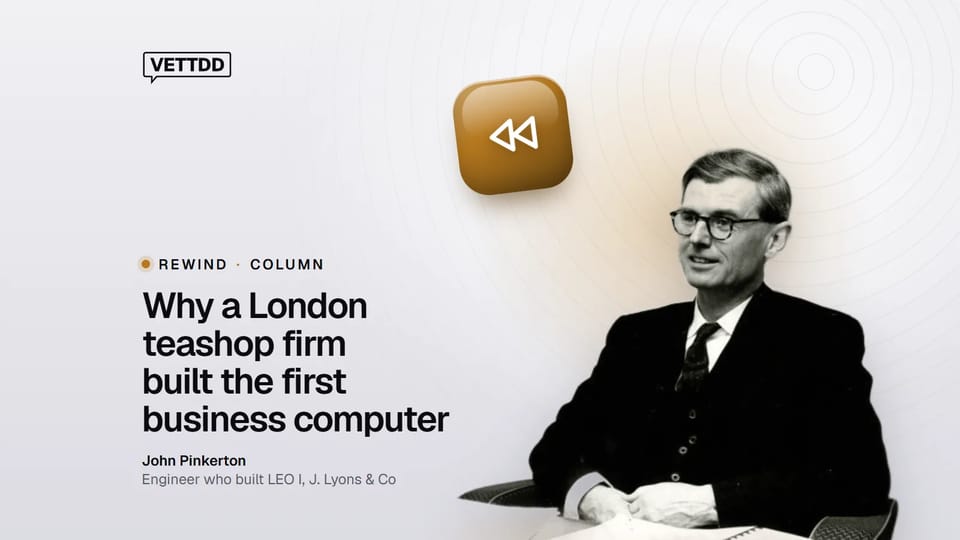
The engineering went to Dr John Pinkerton, who joined Lyons in January 1949 on the recommendation of Maurice Wilkes at Cambridge. The Centre for Computing History says Pinkerton built up the small team that built LEO I, a machine based on EDSAC but significantly modified for business data processing. Its construction took around 2,500 square feet of floor space at Cadby Hall, and its memory sat in tanks of mercury, The Register reported in 2021.
The jobs themselves came from Caminer. As chief systems designer, he personally completed the specification and flowcharting of the earliest applications, and the IEEE proposal credits him with specifying “the first business application of computers both in and outside Lyons”.
Ford bought the pay run
Payroll followed the bakery. Lyons became the first company in the world with a computerized payroll in 1953, and LEO soon took over accounting and stock control for all 180 of the company’s teashops, according to The Register’s 2011 profile. The IEEE proposal records the gain on pay: payslips were completed in 1.5 seconds per employee, without error, against 8 minutes when done by hand.
Other companies wanted the same output. Lyons, the IEEE proposal says, “set themselves up as a computer bureau, and then as a computer manufacturer”. The proposal dates a first live run for the Ford Motor Company to December 1955, when pay produced by LEO I went to the first batch of 700 Ford employees. A supplier running a client’s payroll on its own machine, against the client’s data, is the outline of the bureau and outsourced payroll services that mid-market firms still buy.
Manufacturing ran alongside. LEO Computers Ltd was formed in 1954, and the IEEE proposal says it went on to build 11 LEO II and 61 LEO III computers, 72 in all, sold worldwide. Pinkerton was appointed a director of LEO Computers in 1959.
Lyons merged after 12 years
In 1963, 12 years after Bakery Valuations, Lyons merged its LEO Computers business with English Electric’s computer interests, and the IEEE proposal says it sold its half-stake the following year. Also in 1964, IBM introduced System/360, which The Register describes as a direct rival to LEO III. IBM’s design became the industry standard, and the merged company later sold a clone of it, System 4. The IEEE proposal says LEO’s home market was too small, unlike that of main competitors such as IBM, and that Lyons had not appreciated the ‘backward-compatibility’ appeal of IBM marketing. LEO, by The Register’s account, was sold by “relying solely on word of mouth”. Later mergers carried it into ICL in 1968, according to the Centre for Computing History.
Mainframe hardware went on to consolidate around IBM’s System/360 design, the standard the merged company itself cloned. The work Lyons had built around its computer – studying a clerical process, specifying it and running it for a fee – carried on as systems analysis, bureau processing and outsourced services, none of which depended on who made the machine. Lyons had both trades in one building at Cadby Hall, and by 1964 it had sold its stake in the merged computer business.
Seventy-five years on, the part of the LEO story that still has buyers is the bureau work Lyons first sold with Ford’s pay run, not the machines it built to run it.


Get The VETTDD BriefingThe week in B2B technology, every week.
Subscribe freeSources
- IEEE Milestones (ETHW), “Milestone-Proposal: LEO: First Application of Digital Computing to Business Processes (November 1951)”, milestone proposal, docket 2025-09, page last edited 12 July 2026. https://ieeemilestones.ethw.org/Milestone-Proposal:LEO:_First_Application_of_Digital_Computing_to_Business_Processes_(November_1951)
- LEO Computers Society, “LEO Computers Society”, homepage, accessed 21 October 2026. https://www.leo-computers.org.uk/
- LEO Computers Society, “More about LEO”, web page, accessed 21 October 2026. https://www.leo-computers.org.uk/more/
- Centre for Computing History, “LEO I computer becomes operational”, timeline entry, 5 September 1951. http://www.computinghistory.org.uk/det/6162/LEO%20I%20computer%20becomes%20operational
- Centre for Computing History, “John Pinkerton”, biography, accessed 21 October 2026. https://www.computinghistory.org.uk/det/50939/John-Pinkerton/
- The Register, Chris Bidmead, “Heroes of tech: David Caminer”, profile, 27 September 2011. https://www.theregister.com/2011/09/27/heroes_of_tech_david_caminer/
- The Register, Richard Speed, “Think that spreadsheet in your company’s accounts dept is old? 70 years ago, LEO ran the first business app”, article, 30 November 2021. https://www.theregister.com/2021/11/30/leo_70/

Editor
The VETTDD editorial desk. Interviews, analysis, columns and news briefs on the decisions shaping B2B technology.
More from Editor
The week in B2B technology, in five minutes
Every week: the interview, the briefs that matter and one view from the editor. Free.