

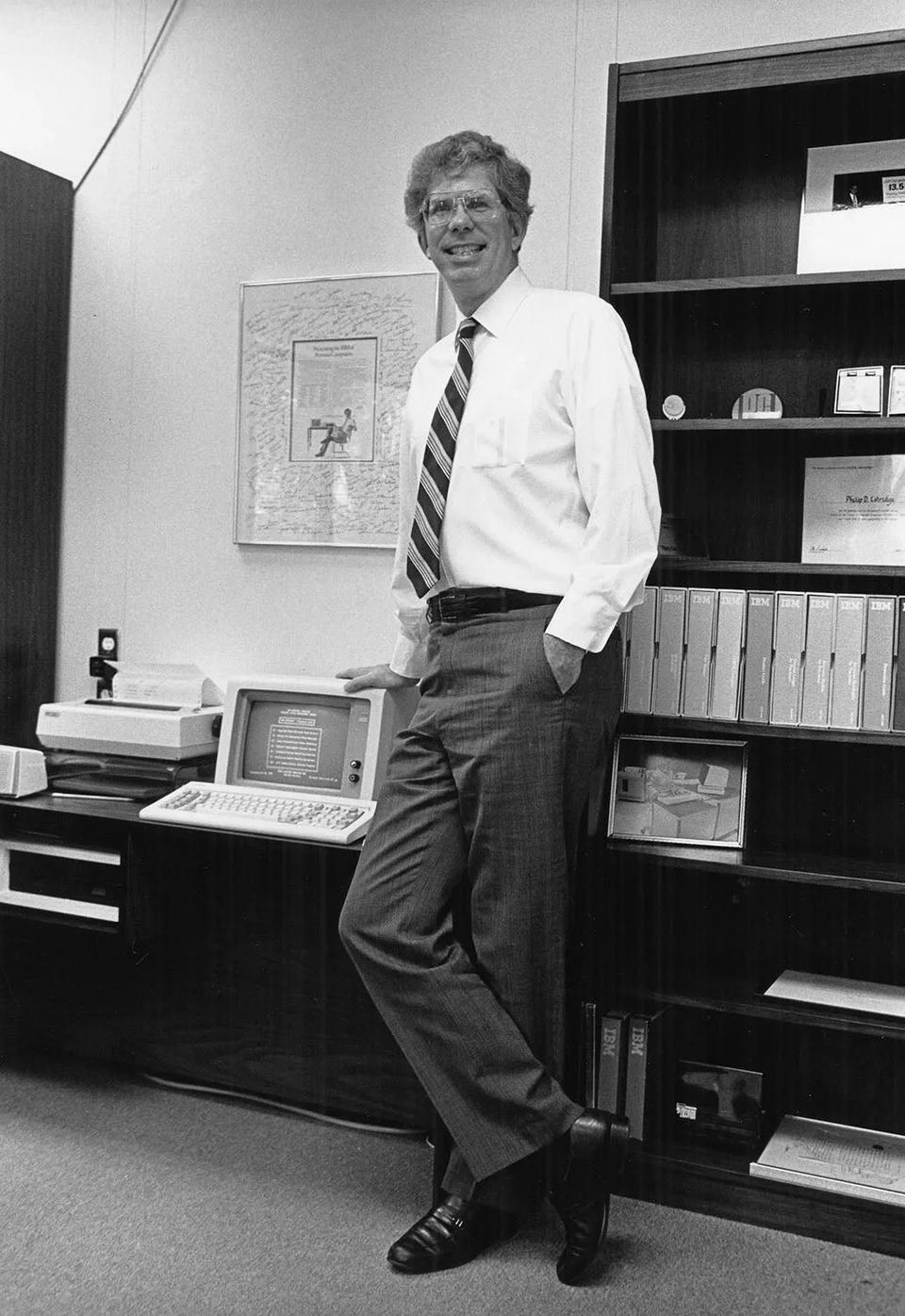
On 12 August 1981 Don Estridge, who led IBM’s personal computer project, unveiled the IBM PC at the Waldorf Hotel in New York. The model 5150 cost $1,565 (about £855 at the Bank of England’s reference rate that day) with 16 kilobytes of memory and no disk drive. A display, two diskette drives and a printer added nearly $3,000.
The machine was built against a deadline. In 1980 William Lowe, director of IBM’s General Systems Division lab in Boca Raton, Florida, pitched chief executive Frank Cary the idea of a computer for small businesses and consumers. Cary gave him a month to develop a prototype and a year to get a product out the door, according to IBM’s own history of the PC. The same account quotes James Cortada, author of a history of the company: “The normal process to get a new product to market took four or five years.”
Before the PC, IBM had designed and made nearly everything it sold. To hit the deadline and a $1,500 price target, Estridge’s team used off-the-shelf parts: Intel’s 8088 processor, an operating system from Microsoft that later became known as MS-DOS, and a dot-matrix printer from Epson. It also published a technical reference of the circuit designs.
IBM made those choices to meet Cary’s deadline. They also set the terms of the market that followed: a standard machine assembled from other companies’ components, sold through dealers and open to anyone who could build a copy. Within a decade IBM held about a fifth of the PC market, by the account in its own history.
Bought-in parts and a published design
More than 750 software packages were available for the PC within a year of launch, IBM says, and hardware makers built for it too. IBM’s history describes the result as “a de facto industry standard and a playground for developers”.
The PC changed how IBM sold as well as how it built. Like many companies at the time, IBM had been selling computers only to businesses. The PC went through retailers such as Sears, Roebuck & Company and ComputerLand, alongside IBM Product Centers and a separate sales unit within its Data Processing Division. By the end of 1982 a new retailer was signing up every week, and at the peak machines were selling at one every minute of every business day, according to the company.
IBM also built the machine in Scotland. A 1983 model 5150 in the Science Museum Group collection, supplied with its display, keyboard, printer and manuals, was made by IBM in Greenock. The museum’s record puts first-year sales at about 200,000 units.
The compatibles arrived by 1983
A few companies took the specifications IBM had released and reverse-engineered the system’s boot code, IBM’s history says, producing machines sold as “IBM compatible”. A compatible ran software written for the IBM PC, so the packages that made IBM’s machine useful also sold rival hardware.
Compaq, formed by three senior managers from Texas Instruments, was the clearest case. In 1983, its first year of shipping products, it took $111m in sales and $4.7m in profit, The Christian Science Monitor reported in April 1984, calling it “the leader in IBM-compatible computers”. Compaq sold only through retailers, among them ComputerLand, Businessland and Sears Business Systems Centers. It had cut its price to dealers by $500, the paper reported, and dealers had been selling its portable for about $2,495.
Compaq used the dealer channel IBM had opened, sold to the same buyers and ran the same software. For a business buyer in 1983, the 12-month brief had produced a choice of suppliers for one standard machine.
A standard IBM no longer led
Cortada sets out the outcome in IBM’s own history: “IBM’s share of the PC market shrank from roughly 80% in 1982–1983 to 20% a decade later.” He adds that IBM continued to sell millions of personal computers, but that over time the profit on its PC business declined.
IBM went on releasing personal computers through the 1980s: the PC-XT with a hard drive in March 1983, the PC Jr in November 1983, the Portable PC in February 1984, the PC-AT in August 1984 and the PC Convertible in April 1986.
The business PC of the late 1980s was settled in Boca Raton in 1980 and 1981 by a team with a year to ship. IBM’s answer to that brief left Compaq and the other compatible makers free to sell through the same retailers and run the same software as the machine they copied.


Get The VETTDD BriefingThe week in B2B technology, every week.
Subscribe freeSources
- IBM, “The IBM PC”, IBM Heritage history page, accessed 21 October 2026. https://www.ibm.com/history/personal-computer
- Science Museum Group Collection, “IBM PC Model 5150 with printer”, object record (made by IBM, Greenock, 1983), accessed 21 October 2026. https://collection.sciencemuseumgroup.org.uk/objects/co63962
- The Christian Science Monitor, Francine Kiefer, “A fledgling in portable computers carries profits to the bank”, news article, 5 April 1984. https://proof.csmonitor.com/1984/0405/040513.html
- Pound Sterling Live, “British Pound / US Dollar Historical Reference Rates from Bank of England for 1981”, data table (12 August 1981: 1.8295), accessed 21 October 2026. https://www.poundsterlinglive.com/bank-of-england-spot/historical-spot-exchange-rates/gbp/GBP-to-USD-1981

Editor
The VETTDD editorial desk. Interviews, analysis, columns and news briefs on the decisions shaping B2B technology.
More from Editor
The week in B2B technology, in five minutes
Every week: the interview, the briefs that matter and one view from the editor. Free.