

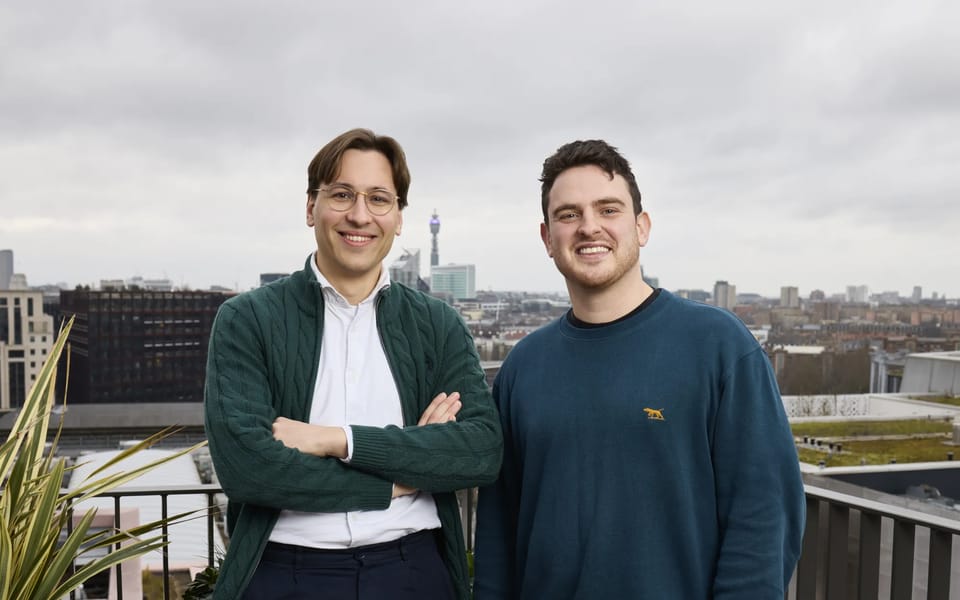
On 20 August, Callosum, a London company whose software decides which AI model and which chip should handle each step of a workload, announced a $100m (£73.5m) seed round led by Atomico. Callosum says Plural, which led its $10.25m (£7.5m) pre-seed in February, and DCVC participated significantly, alongside other investors and angels.
Callosum Ltd was incorporated on 13 November 2024 with Dr Jascha Achterberg and Dr Danyal Akarca as its directors, and the two founders control it through a holding company, Callosum Technologies, according to Companies House. Both hold neuroscience doctorates from the University of Cambridge, DCVC said in its note on the round, which names Akarca as co-founder and chief executive. The founding idea comes from biology: the company’s announcement of the round calls its approach heterogeneous intelligence and says “it is how nature evolves intelligence”.
In practice that means breaking an AI workload into its component tasks and sending each one to the model and chip that runs it best, within limits of cost, energy and speed. Callosum calls the result Tailored Inference and sells it through a family of APIs. Alongside the round it announced a flagship partnership with Cerebras, the maker of wafer-scale AI chips, and another with the chipmaker Rebellions.
The pitch to any business running AI agents is that its bill depends less on which model it buys than on how the work is cut up and where each piece runs. The round gives Callosum the staff and compute to show that across many customers. For now the evidence comes from three software companies, and all of it was published by Callosum on the day of the raise.
What three customers measured
HelmGuard, which builds an agent platform for governance, risk, compliance and security, used Callosum to check agent activity for leaks of sensitive data. Callosum says one configuration analyzed completed traces for $0.08 per 1,000, 77 times cheaper than a single closed-source frontier model doing the same job. A real-time configuration on Cerebras hardware returned a verdict 10 times faster than the real-time baseline at less than half the price, Callosum says.
Round Treasury, which automates finance work from treasury management to accounts payable and payroll, runs invoices and receipts through a multi-step extraction pipeline. Through Callosum, mean extraction time fell from 15.9 seconds to 2.1 seconds per document, Callosum says. Hayyaan Ahmad, Round Treasury’s co-founder, said the speed-up “allows the team to improve the product by having the document ingested live on the dashboard instead of in the background”.
Deliverance AI, which runs governed agents inside its customers’ own infrastructure, measured a workflow those customers already use. “A four-agent workflow our customers run every day went from sixty-four seconds to six and a half,” said Mick McNeil, its chief executive, in Callosum’s write-up. “Our customers do not buy tokens, they buy outcomes, and this is return on investment they can measure with a stopwatch.”
No independent benchmark sits behind these figures. They are case studies on Callosum’s own blog, written up with the customers involved.
Why agents change the arithmetic
The case for the round rests on how agents use models. A chatbot answers a question once; an agent loops, calling a model at each step and often before each tool it uses. Jason Pontin, a general partner at DCVC, wrote that the unit cost of inference “isn’t falling fast enough on rented hyperscaler infrastructure to offset the exploding number of model calls that advanced AI workflows now require”.
In HelmGuard’s case, Callosum says a real-time check built on a single closed-source model adds 2.77 seconds and $8.98 per 1,000 traces to every outbound tool call, a price at which, it argues, such monitoring runs only on a sample of traffic, on the riskiest customers or not at all. Its own Cerebras configuration returns a verdict in 0.28 seconds, and a balanced one decides in 0.53 seconds for $0.34.
Akarca puts the argument in the terms of his training. “The industry has been betting that one model or one kind of chip will rule them all,” he said in DCVC’s announcement. “But nature shows us the opposite. Intelligence is collective and will emerge from many specialized systems working together.”
What the seed money pays for
DCVC said the round will help Callosum expand its team, accelerate research and development and buy compute. Pontin also named the commercial bet: Callosum aims to be “the Switzerland of AI orchestration”, independent of any model or chip supplier. He argued that AI companies and hyperscalers have a vested interest in pushing their own models and chips, which leaves room for a neutral layer between them.
The fastest HelmGuard configuration runs on Cerebras, and so does the comparison DCVC cites, in which Callosum found that Llama 70B delivered the same accuracy as ChatGPT 5 at five times the speed and one-fifth the cost.
Six months after announcing its $10.25m pre-seed, Callosum has raised almost 10 times that sum and has three named customers willing to put numbers on the record. With the new money, the 77-fold and 10-fold claims now have to hold for customers beyond the three on its 20 August blog.


Get The VETTDD BriefingThe week in B2B technology, every week.
Subscribe freeSources
- UKTN, “Callosum raises £73.5m to ‘redefine how humanity computes’”, news article, 20 August 2026. https://www.uktech.news/ai/callosum-raises-73-5m-to-redefine-how-humanity-computes-20260820
- Callosum, “$100M Seed to Redefine How Humanity Computes”, company blog announcement, 20 August 2026 (Wayback Machine snapshot 20 August 2026). https://web.archive.org/web/20260820202048/https://www.callosum.com/blog/seed-round
- Callosum, “Pushing the Efficiency Frontier with Tailored Inference”, company blog case studies, 20 August 2026 (Wayback Machine snapshot 20 August 2026). https://web.archive.org/web/20260820163050/https://www.callosum.com/blog/tailored-inference
- DCVC, “DCVC joins $100 million seed round to power Callosum, builder of a new orchestration layer for heterogeneous AI”, investor announcement by Jason Pontin, 20 August 2026. https://www.dcvc.com/news-insights/dcvc-joins-100-million-seed-round-to-power-callosum-builder-of-a-new-orchestration-layer-for-heterogeneous-ai/
- Callosum, “Introducing Callosum”, company blog announcement, 26 February 2026. https://callosum.com/blog/introducing-callosum
- Callosum, team page (Wayback Machine snapshot 20 August 2026). https://web.archive.org/web/20260820163050/https://www.callosum.com/team
- Companies House, Callosum Ltd (16076949), company record, officers and persons with significant control. https://find-and-update.company-information.service.gov.uk/company/16076949
- Companies House, Callosum Technologies Ltd (16646869), company record, officers and persons with significant control. https://find-and-update.company-information.service.gov.uk/company/16646869
- Tech.eu, “Callosum raises $100M seed round”, news article, 20 August 2026. https://tech.eu/2026/08/20/callosum-raises-100m-seed-round/

Editor
The VETTDD editorial desk. Interviews, analysis, columns and news briefs on the decisions shaping B2B technology.
More from Editor



The week in B2B technology, in five minutes
Every week: the interview, the briefs that matter and one view from the editor. Free.