

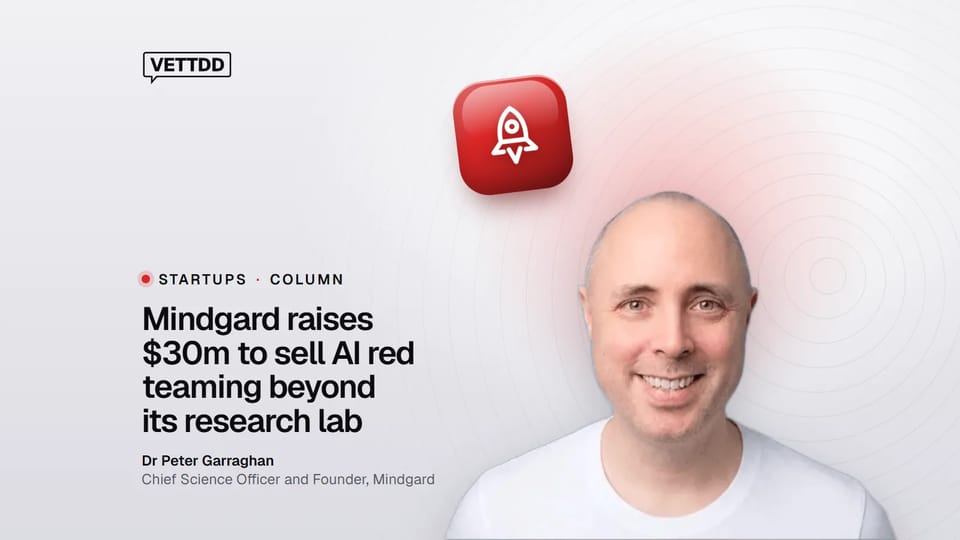
On 12 August, Mindgard announced a $30m (£22.2m) Series A led by Album VC. Karma Ventures joined the round, alongside four existing backers: .406 Ventures, Atlantic Bridge, IQ Capital and Lakestar. The company, which has offices in London and Boston, said the money would go on scaling its product, engineering, sales and marketing teams.
Mindgard sells security testing for AI systems. Its platform looks for the AI tools staff use without approval – what the industry calls ‘shadow AI’ – runs automated attacks against AI models, agents and applications, and protects them while they run. The company says the platform has uncovered more than 150 publicly disclosed vulnerabilities in widely used AI products. Its examples are a zero-day code execution flaw in the Cursor coding tool, a flaw in Google’s Antigravity and failures in the image-generation guardrails of OpenAI’s ChatGPT.
The idea came out of a university department. Mindgard Ltd was incorporated at Companies House on 20 May 2022, with a registered office on Lime Street in the City of London. According to the company, it was built on research by Dr Peter Garraghan at Lancaster University which showed that traditional application security could not deal with risks specific to AI. Garraghan, a professor at Lancaster, has been a director since incorporation. When Mindgard raised $8m in December 2024, in a round led by .406 Ventures with Atlantic Bridge, Willowtree Investments, IQ Capital and Lakestar, he was its chief executive.
The Series A pays for something different from what built the company. Mindgard’s reputation rests on finding and publishing flaws in other companies’ AI products. Its new backers are funding a push into large enterprises, with sales and marketing alongside product and engineering in the plan, and the public evidence for that side of the business is much thinner than the evidence for the research.
A research spinout with an outside chief
The leadership has already changed to fit. Mindgard says it hired James Brear as chief executive in 2025, and Companies House lists him as a director from 15 September 2025. The company’s own site now gives Garraghan’s title as chief science officer and founder. The same 2025 hiring round brought in Aaron Portnoy, now chief product officer, and Rich Smith, now vice-president of research.
Brear framed the round around the size of the problem. “AI is creating an entirely new attack surface and organizations need a fundamentally different approach to securing it,” he said in the announcement. He added that the investment would help make attacker-driven AI security “a core part of how organizations implement and manage AI”.
Ty Boswell, a partner at Album VC, made the case in commercial terms. “Organizations are moving AI into critical operations without security infrastructure designed for how these systems operate in practice,” he said. “We believe this team can define the AI security category.”
Customers the company does not name
The announcement says the round follows accelerated deployment of Mindgard within a large number of the Fortune 2000 and AI innovators, across financial services, pharmaceuticals, gaming, digital services, semiconductors and healthcare. It names none of those businesses. Kristjan Laanemaa, founding partner at Karma Ventures, said “some of the most demanding F2000 enterprises rely on it to safeguard their AI systems”, again without names.
The company’s own website is no more specific. Its milestones list Fortune 500 design partners secured in 2026. Its customer case studies describe a global development and financial institution, a global semiconductor manufacturer, a healthcare AI platform and a global enterprise technology services provider, each kept anonymous. That means that the strongest public evidence for Mindgard’s product is still the vulnerabilities it has disclosed in other vendors’ tools, not a customer saying what it bought.
Why attack testing has reached the budget
The gap Mindgard is selling into is described in its own research, a survey by the vendor that sells the fix. In June 2025 the company published the results of a survey of more than 500 cybersecurity professionals at RSA Conference 2025 and Infosecurity Europe 2025. More than half (56%) said employees in their organization used AI without approval or oversight, and only 32% of organizations had formal controls in place. Asked who owned AI risk in their organization, 39% said no one.
The respondents were not only from large enterprises: 31% came from firms with 100 to 999 employees and 32% from businesses with fewer than 100 staff. Laanemaa described the product as “combining automated reconnaissance with smart penetration testing”. A $30m round to sell that as a continuous platform treats attacks on AI systems as a recurring line in a security budget, rather than a one-off audit commissioned from a research lab.
Mindgard has shown it can find serious flaws in AI products made by some of the largest companies in the field, and publish them. With the Series A, an outside chief executive and a founder moved into the science role, its backers have bet that the same research can be sold as a platform to enterprises that have not been named. So far, the evidence that enterprises are buying sits in the statements of Mindgard and its investors rather than in any customer Mindgard has named.


Get The VETTDD BriefingThe week in B2B technology, every week.
Subscribe freeSources
- Mindgard, “Mindgard Raises $30M Series A by Turning Attacker Behavioral Intelligence into Effective AI Defense”, press release via Business Wire (syndicated on Yahoo Finance), 12 August 2026. https://finance.yahoo.com/technology/ai/articles/mindgard-raises-30m-series-turning-130000918.html
- Business Wire, “Mindgard Raises $30M Series A by Turning Attacker Behavioral Intelligence into Effective AI Defense”, press release, 12 August 2026. https://www.businesswire.com/news/home/20260812503461/en/Mindgard-Raises-$30M-Series-A-by-Turning-Attacker-Behavioral-Intelligence-into-Effective-AI-Defense
- UKTN, “Lancaster spinout Mindgard raises £22m to scale AI security platform”, news, 13 August 2026. https://www.uktech.news/ai/lancaster-spinout-mindgard-raises-22m-to-scale-ai-security-platform-20260813
- Companies House, Mindgard Ltd (14120558), company record, officers and persons with significant control. https://find-and-update.company-information.service.gov.uk/company/14120558
- Mindgard, “About”, company web page, Wayback Machine snapshot of 22 July 2026. https://web.archive.org/web/20260722071708/https://mindgard.ai/about
- Mindgard, “Mindgard raises $8M to accelerate industry-first AI security solution”, company blog, December 2024. https://mindgard.ai/blog/mindgard-raises-8m-industry-first-ai-security-solution
- Mindgard, “Research: Shadow AI is a Blind Spot in Enterprise Security, Including Among Security Teams”, company research, 16 June 2025, Wayback Machine snapshot of 22 October 2025. https://web.archive.org/web/20251022221330/https://mindgard.ai/resources/shadow-ai-is-a-blind-spot
- Mindgard, customer case studies (global development and financial institution; global semiconductor manufacturer; healthcare AI platform; global enterprise technology services provider), Wayback Machine snapshots of 16 July 2026. https://web.archive.org/web/20260716234558/https://mindgard.ai/customers/applying-an-attackers-mindset-to-secure-ai-systems-in-a-global-development-and-financial-institution

Editor
The VETTDD editorial desk. Interviews, analysis, columns and news briefs on the decisions shaping B2B technology.
More from Editor


The week in B2B technology, in five minutes
Every week: the interview, the briefs that matter and one view from the editor. Free.