

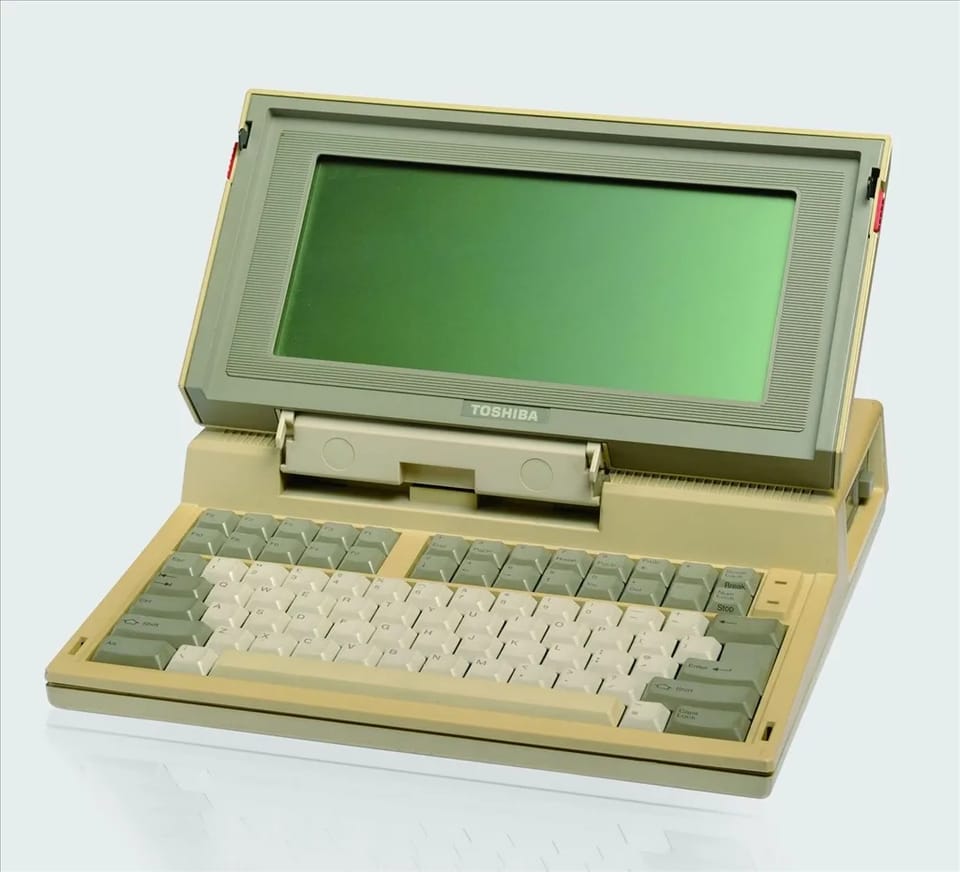
Toshiba showed the T1100 at the Hanover fair in April 1985 and put it on sale in Europe soon after. It was a battery-powered laptop that ran software written for the IBM PC, with a liquid crystal display, a keyboard and a 3.5-inch disk drive in a case that folded shut. Toshiba calls it the world’s first laptop PC. The portables before it, from Compaq, Seiko and NEC, were either the size of a suitcase or could not run IBM software, according to Toshiba’s account of the project for the IEEE.
The T1100 began with Atsutoshi Nishida, senior vice president of Toshiba Europe since March 1984. In 1983 he had led a small Toshiba team in Los Angeles, working with McKinsey on how the company could return to the US computer market after a desktop PC that failed there because it could not run IBM software. Their answer was a clamshell computer with a flat screen that was compatible with the IBM PC, Nishida later told IDG News Service.
Tokyo was not convinced. Senior managers doubted that buyers would accept such a computer under the Toshiba name, and the companies Nishida offered it to, to sell under their own brands, all turned it down, he said. Approval came only after he promised to sell 10,000 in a year, which he described as a very large number at the time.
Even then, Toshiba’s management gave the project no development money, and the PC division could not afford it. Nishida paid for the work from his international sales and marketing budget, Nobuyuki Tanaka, one of the engineers on the project, told IDG. Tanaka’s team started in April 1984 and had a prototype by August. Toshiba developed most of the key parts in-house, including the chips, the disk drive and the screen, its science museum says.
Software on small disks
The disk drive that made the T1100 small also left it with nothing to run. Software for the IBM PC shipped on 5.25-inch disks, and no software was available on the smaller format, which had just come out. Nishida put it plainly to IDG: “With no software it could run, our product would be just a box.”
He took the problem to Lotus Development’s office in Windsor, west of London, and asked its European sales manager for a version of the Lotus spreadsheet on the smaller disk. The answer was no on his first, second and third visits. On the fourth, Nishida said, the manager agreed to speak to an engineer as a personal favor, and the spreadsheet was moved across. Ashton-Tate, the maker of dBase, agreed much faster, helped by the news that Lotus was converting.
Compatibility with the IBM PC was the T1100’s whole case, and it counted only once the programs buyers used at their desks came on its disks. Lotus’s agreement gave Nishida something to show the next software house he called on. Toshiba’s own account says its staff made repeated visits to software vendors before they agreed to release on the new disks.
The UK price
The machine was due in UK computer shops that autumn. Personal Computer World, reviewing it in November 1985, put the basic T1100 at £1,950. Toshiba supplied no software with it at all: MS-DOS on disk, with its manuals, cost £50 more, and the mains adapter was extra.
The software Nishida had chased was still arriving. The magazine reported that Toshiba was persuading some of the top software houses to move their programs to the smaller disks, and Toshiba told it the machine ran the Lotus spreadsheet. The reviewer could test it only with a WordStar disk Toshiba sent and with programs taken from the Kaypro 2000, which all ran. He leaned slightly toward the Toshiba over the Kaypro.
Toshiba sold the T1100 on what a business user could take away from the desk. An advert for the machine in the same issue asked: “How many IBM PC compatible computers do you know that you can put into your briefcase at the end of the day?” Inside the company, the concept was “revolution on the desk top”, and the design target was “anywhere, anytime, anyone”, according to Toshiba’s account, which says the company aimed its promotion at business users who were not computer experts.
The sales target
Nishida spent the summer of 1985 visiting large European companies, and used purchases by their competitors to win further deals, IDG reported. He said he finished 230 machines short of his target and sold those soon after.
Toshiba followed in January 1986 with the T2100 and T3100, mains-powered models with faster processors, one of them with a hard disk, after buyers asked for more speed and storage. Dataquest figures quoted in Toshiba’s account put Toshiba’s share of the portable PCs shipped in Europe in 1987 at about 40%.
The T1100 reached buyers on Nishida’s budget and his sales target, and on a Lotus manager in Windsor who agreed on the fourth visit. Nishida said he kept his promise, and the programs that made the machine worth carrying reached its disks one software house at a time.


Get The VETTDD BriefingThe week in B2B technology, every week.
Subscribe freeSources
- Martyn Williams, IDG News Service, “Persistence in pioneering a laptop”, Network World, 25 April 2005. https://www.networkworld.com/article/863815/data-center-persistence-in-pioneering-a-laptop.html
- Martyn Williams, IDG News Service, “Developing Toshiba’s first laptop”, Computerworld Singapore, 21 April 2005 (archived printout). https://www.minuszerodegrees.net/manuals/Toshiba/Other/Toshiba%20T1100%20-%20Computerworld%20Singapore%20-%20Developing%20Toshiba's%20first%20laptop.pdf
- Nick Walker, “Toshiba T1100 vs Kaypro 2000”, review, and Toshiba T1100 advertisement, Personal Computer World, November 1985. https://archive.org/details/PersonalComputerWorld1985-11
- IEEE Milestones (ETHW), “Toshiba T1100, a Pioneering Contribution to the Development of Laptop PC, 1985”, milestone citation and historic significance statement, page last edited 14 June 2022. https://ethw.org/Milestones:Toshiba_T1100%2C_a_Pioneering_Contribution_to_the_Development_of_Laptop_PC%2C_1985
- Toshiba Science Museum, “World’s First Laptop PC”, exhibition guide, accessed 23 November 2026. https://toshiba-mirai-kagakukan.jp/a-guide/en/history-zone/ichigoki/laptop-pc.htm
- Toshiba, “Atsutoshi Nishida”, press release background, 22 February 2005. https://www.global.toshiba/ww/news/corporate/2005/02/pr2201/shiryo.html

Editor
The VETTDD editorial desk. Interviews, analysis, columns and news briefs on the decisions shaping B2B technology.
More from Editor
The week in B2B technology, in five minutes
Every week: the interview, the briefs that matter and one view from the editor. Free.