

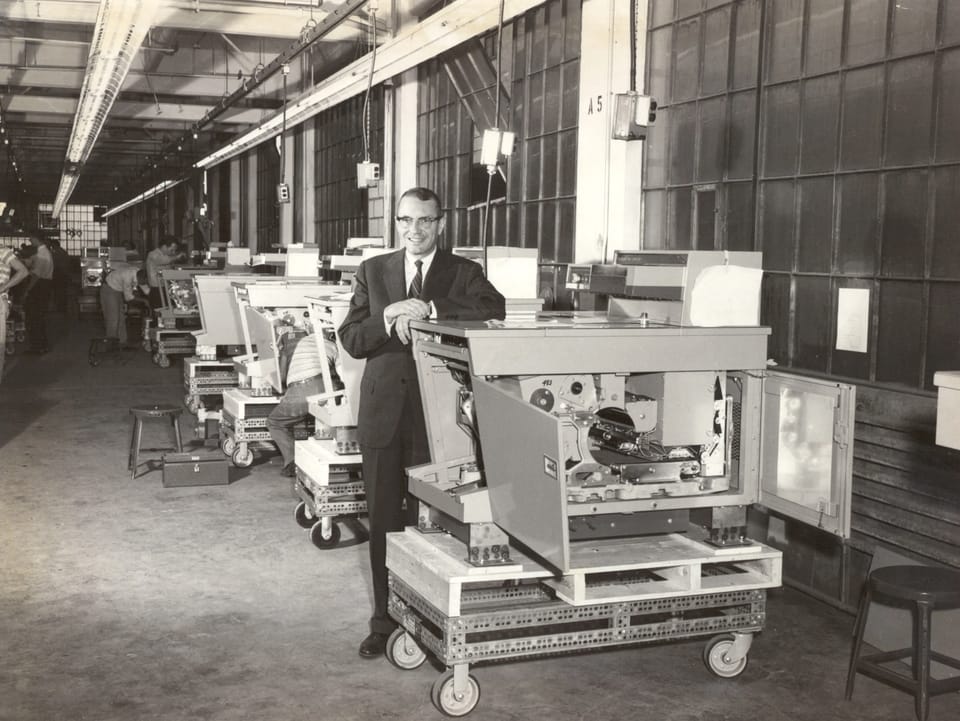
Haloid Xerox, a photographic paper maker in Rochester, New York, announced the Xerox 914 to the public on 16 September 1959 in a demonstration shown on television. The machine made copies on plain paper at the touch of a button. Developing it had cost about $12.5m (about £4.4m), which the company’s published history, The Story of Xerography, puts above its total earnings in the ten years from 1950 through 1959.
Offices already had ways to copy a document. The mimeograph needed a master to be made first, the Photostat was slow and costly, the Thermo-Fax needed treated paper and Kodak’s Verifax produced damp copies that had to be dried. Chester Carlson, a patent attorney, had made the first xerographic image in 1938 and spent years failing to interest a manufacturer in it. The Battelle Memorial Institute took up his process in 1944, and Haloid licensed it from Battelle with effect from 1 January 1947.
Joseph C Wilson, Haloid’s president, later wondered aloud why Battelle had picked so small a company. “Financially we were very limited. We had a limited marketing organization and a limited research group. I guess what sold them was that we were going to make or break with it,” he said, in remarks the company history records. Battelle, he added, was afraid that bigger companies would have it “as a side issue, on the back burner”.
The cost of development
The bill grew through the 1950s. Wilson feared that Haloid’s revenues were too small to pay for an office copier and considered sharing the project with larger companies that had the money. His approaches were rejected, the history says. John Brooks, who profiled Xerox for The New Yorker in 1967, reported that Haloid at one point considered selling most of its xerography rights to IBM before the deal was called off. In 1955 Haloid took full title to Carlson’s patents and the whole cost of development, paying Battelle in Haloid shares.
The money came from profits, borrowing and new shares. Brooks reported that Wilson and other executives took most of their pay in stock, and that some put up their savings and the mortgages on their houses. John Dessauer, Haloid’s head of research, told Brooks he had mortgaged his own house, and that the company’s marketing people expected to sell a few thousand machines at most. Peter McColough, who joined in 1954 and later became president, told Brooks that until 1959 Haloid had been a small company staking itself on a risky bet.
Rank and the first orders
In 1956 Haloid formed Rank Xerox with the UK’s Rank Organisation, a joint venture to manufacture and market Haloid equipment, initially in Europe and eventually in Africa and Asia, according to Xerox’s company timeline.
The first Xerox 914 was shipped to a customer in March 1960. Predictions at the time were that perhaps 5,000 units would be placed in three years. By the end of 1962 the company had shipped 10,000 and its manufacturing staff had a backlog of orders. Xerox hurried to keep up with demand, the history says, hiring and training a sales and service force from scratch.
Demand nobody forecast
David Owen, writing in Smithsonian magazine in 2004, reported that Carlson had worried, before the launch, that few businesses would ever need to make 100 copies a day, the level at which he thought xerographic copying would be economical. The first companies to receive the machine were turning out 2,000–3,000 copies a day. Owen put this down to how easy the machine was to use: it needed no special paper or chemical developer, and the copy did not curl or turn brown.
By 1967, Brooks reported, a customer could buy the machine outright or rent one for $25 a month and pay 4 cents for each copy, with a minimum copy charge. He wrote that the charges were set deliberately to favor renting, because Xerox ultimately made more money that way.
Under those terms the company’s income from a rented machine rose with the number of copies its customer made. In 1965, the company told Brooks, the machine accounted for about 62% of its operating revenues.
Net income had risen from $2m in 1959 to $22.6m in 1963, according to the company history. Haloid Xerox took the name Xerox in 1961, the year its shares were listed on the New York Stock Exchange.
By 1963 the questions Haloid could not answer in 1959, whether the copier would work and whether it would sell, had been settled. Nobody at the company had predicted how many copies offices would make on it, and in 1967 Xerox charged its renters for each one.


Get The VETTDD BriefingThe week in B2B technology, every week.
Subscribe freeSources
- Xerox, “The Story of Xerography”, company history, accessed 12 November 2026. https://www.xerox.com/downloads/dl/usa/en/innovation/innovation_storyofxerography.pdf
- Xerox, “Xerox History Timeline”, company timeline, accessed 12 November 2026. https://www.xerox.com/en-us/about/history-timeline
- John Brooks, “Xerox Xerox Xerox Xerox”, The New Yorker, 1 April 1967. https://www.newyorker.com/magazine/1967/04/01/xerox-xerox-xerox-xerox
- David Owen, “Making Copies”, Smithsonian magazine, August 2004. https://www.smithsonianmag.com/innovation/making-copies-2242822/
- Lawrence H. Officer, “Dollar-Pound Exchange Rate From 1791”, MeasuringWorth (1959: $2.81), accessed 12 November 2026. https://www.measuringworth.com/datasets/exchangepound/result.php?year_source=1958&year_result=1967

Editor
The VETTDD editorial desk. Interviews, analysis, columns and news briefs on the decisions shaping B2B technology.
More from Editor
Hewlett and Packard formalize their partnership and toss for the name
Chester Carlson makes the first xerographic copy above an Astoria bar
IBM adopts an 80-column punched card that only its machines can read
SAP built its first system at ICI in 1972 and would not cut the price
The week in B2B technology, in five minutes
Every week: the interview, the briefs that matter and one view from the editor. Free.