

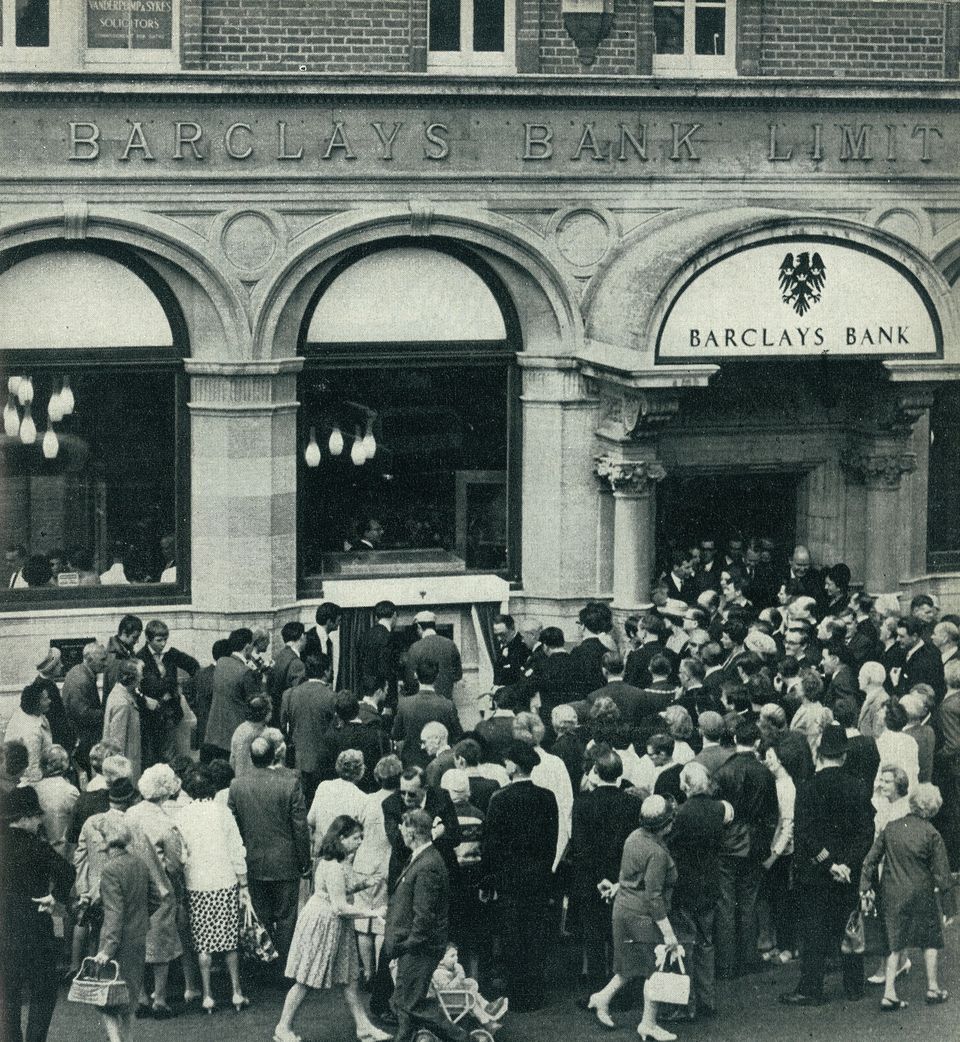
On 27 June 1967 Sir Thomas Bland, deputy chairman of Barclays, drew back a velvet curtain at the bank’s Enfield branch in north London and unveiled a cash dispenser. The comedy actor Reg Varney made the first withdrawal in front of a crowd. The most he, or anyone, could take out was £10.
Barclays called the service Barclaycash. Its archive describes the machines as “robot cashiers”, introduced so the bank could run a 24-hour service 365 days a year. Until then, cash meant a visit to a branch during banking hours. A teller at Enfield at the time has recalled that the branch was open only until 3:30pm. Bland pitched the machine at the opening as “a little bank in itself… Open for business 24 hours a day throughout the year, it is an exciting development and an earnest example of Barclays’ desire to come to terms with the needs of modern society.”
The machine drew a crowd, but its commercial reach came later, from two decisions that had little to do with the box on the wall: a plastic card that tied the machine to a customer’s account in 1975, and a 1986 agreement that let Barclays cardholders draw cash from three rival banks’ machines. The 1967 dispenser extended one bank’s opening hours at a handful of branches. The card and the shared network let a customer of any of the four banks draw cash outside banking hours at the machines of all four.
A machine built around a voucher
The idea came from outside the bank. John Shepherd-Barron, managing director at the banknote maker De La Rue, found he could not cash his checks after his bank closed on a Saturday morning, according to Barclays’ account. Within days Barclays had agreed to work with De La Rue on the first six machines, and then a further 50. The machines were developed jointly by De La Rue Instruments and the bank’s own Management Services Department over 18 months.
A customer put a special paper voucher – a check impregnated with carbon-14, a mildly radioactive substance – into a drawer and keyed in a personal code, which Barclays now calls the forerunner of the personal identification number (PIN). The machine paid out £10 against each voucher. The six machines went outside selected branches. Barclays’ archive records that they were vandalized at first and still proved popular.
Barclays was not working alone on the problem. Its own archive concedes that at least four similar devices were under way around the world in the mid-1960s, and describes the Enfield machine as earning the ‘world’s first’ label “by an impossibly narrow margin”.
Barclays had ordered its first electronic computer, an Emidec 1100, in 1959 to cut repetitive work as the volume of checks and credit slips rose. Its account of the cash machine gives a similar reason: more people were taking their money to the bank, and the bank wanted to increase efficiency while improving customer service.
From paper voucher to plastic card
Barclays had launched Barclaycard, its credit card, in 1966, aiming to sign up one million cardholders by the June launch date.
By the 1970s the machines had been refined to offer bank statements and deposits as well as cash, once the customer entered a card and PIN. On 30 June 1975 Barclays launched a more sophisticated auto-teller service, Barclaybank, first at its High Street and Cornmarket Street branches in Oxford. The machines were operated with a plastic card bearing the Barclaybank name.
A voucher machine dispensed a fixed sum against a slip the bank had already issued. A card machine sat on top of the customer’s account and could take on other counter work, which is what the statements and deposits did. In 1987 Barclays added a debit card, Barclays Connect, which could also be used to withdraw cash from its machines. Nine months after launch, the bank had issued one million of them.
Sharing the network with rivals
In 1986 Barclays decided to link its auto-tellers with those of Lloyds, Royal Bank of Scotland and Bank of Scotland, so that Barclaybank holders could withdraw cash from any of the four banks’ machines. In 1988 the West of England Building Society joined the reciprocal arrangement.
Before the link, a Barclays machine served Barclays customers. After it, a rival’s machine on another high street served them too, and Barclays’ machines served the rivals’ cardholders in return.
The 1967 machines came from De La Rue. In 1986 a Barclaybank machine was unveiled at an NCR factory, and in 1990 the 10,000th ATM built by NCR, a Barclaybank, was installed as a working exhibit at the Science Museum in Kensington. The machines also left the branch. On 22 May 1998 Barclays opened a drive-through cash machine at Hatton Cross, near Heathrow Airport. By 1999 its network had reached 3,200 machines.
The arithmetic of the 1967 launch was modest: six machines, £10 a time and a paper voucher for each withdrawal. Barclays claimed the world’s first cash machine by a narrow margin, by its own account. The decision that put a cash machine within reach of its customers on other banks’ high streets came 19 years later, when it let its cardholders use three rivals’ machines and opened its own to their customers in return.


Get The VETTDD BriefingThe week in B2B technology, every week.
Subscribe freeSources
- Barclays Group Archives, “Cash machines”, archive story, accessed 21 October 2026. https://home.barclays/archive-barclays/stories/Cash-machines/
- Barclays, “From the archives: the ATM is 50”, news article, 27 June 2017. https://home.barclays/news/2017/06/from-the-archives-the-atm-is-50/
- Barclays, “From the archives: paving the way in tech innovation”, news article, 25 March 2022. https://home.barclays/news/2022/03/From-the-archives-paving-the-way-in-tech-innovation/

Editor
The VETTDD editorial desk. Interviews, analysis, columns and news briefs on the decisions shaping B2B technology.
More from Editor
The week in B2B technology, in five minutes
Every week: the interview, the briefs that matter and one view from the editor. Free.